

 The Gordon Model–what is it exactly? Why learn it and how will it help you?
Hopefully the information below helps answer those questions.
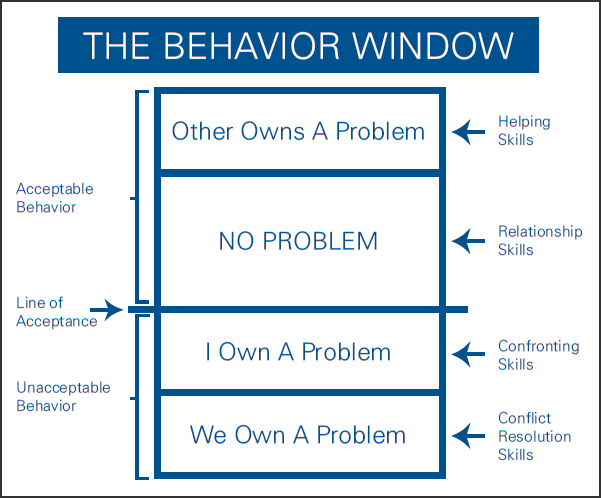
1. The overall goal of the Gordon Model is to reduce relationship problems to increase the amount of productive work time. The purpose of the Behavior Window is to help you identify who is having a problem so you’ll know which skill to use.
2. In contrast to the Roadblocks, Active Listening encourages the other person, who has the problem, to say more about it.
3. Active Listening is an empathic way of reflecting back both the words and feelings the troubled person has expressed, to see if you have understood correctly.
4. Active Listening gives the other person a chance to express their feelings and to move from a superficial problem to the deeper, more basic problem. It keeps responsibility with the other person and allows them to find their own solution.
5. You-Messages point the finger of blame—they cause others to feel put down or criticized. They damage relationships and they are not effective in motivating the other person to change.
6. In contrast to the You-Message, a far more effective approach when another person’s behavior is interfering with your needs, is to send them an I-Message. You take responsibility for your unmet need—you’re proactive. You tell the other person how their behavior is affecting you and that gives them an opportunity to voluntarily modify it.
7. When your I-Message does not immediately result in a change in the other’s behavior which caused you a problem, it is important to stop sending and to shift gears to listening.
8. Often, when the other person hears your I-Message, they respond with resistance, defensiveness, hurt or anger.
9. Shifting gears to listen to them with empathy lets the other person know you aren’t out to get your needs met at their expense. Once their emotional temperature is lower, you can send another I-Message.
10. Active Listening after an I-Message can uncover both feelings as well as information that indicates that you and the other person have a conflict.
11. In the Behavior Window, we would now be in the “We Own A Problem” section.
12. Method III is a process for arriving at a solution which is genuinely acceptable to both you and the other person because it meets both of your needs.
13. First, it’s important to get the agreement of the other person to participate in Method III. Then, both you and the other person identify your real needs as distinguished from your chosen solutions to meet those needs. The next step is for you to work together to generate a number of alternative solutions without any evaluation. That’s done in Step 3. Next, you make a mutual decision about which solution or solutions will best meet both your needs. Then it’s time to discuss who does what by when and agree to check back to see if the solution worked. With Method III, the creativity of both people is utilized and there’s high motivation to carry out a solution since both participated in the decision-making. Conflicts are no longer seen as bad, but as problems to be solved. Method III builds trust and strengthens relationships.